




Financial models and forecasts are common terms for financial professionals. They are the tools that facilitate analysis and decision-making for companies and businesses. In this guide, we explore each concept in-depth and discuss the similarities and differences between the two.
Financial modeling
Financial modeling refers to the procedure of summarizing an organization’s income and expenditures in a systematic way that can be used to determine future earnings and revenue and their impact on the company’s profitability for better decision-making. It is the numerical representation of almost all characteristics of a corporation’s previous, existing, and future operations. Multiple models can conclude different results; however, the model’s efficiency depends on the validity and accuracy of assumptions and inputs.
Financial modeling significance and implication
The financial model has multiple uses for senior management, BOD, and stakeholders of the company. Financial professionals and analysts use it to evaluate the impact of internal and external future events and forecasted economic changes on a company’s value and performance. It is also used to estimate a company’s valuation and compare its performance with its competitors in the sector. Executives can estimate the cost of investing in new projects and assess their profitability to make rational decisions considering calculated risks.
Financial models facilitate executives in decision-making related to raising capital (either via debt or equity), merging with a company or acquiring a company, investing in new projects (new market or product development), business diversification, budget allocation, and business valuation. Financial models can indicate a picture of a company’s existing and predicted financial position.
During the COVID-19 pandemic, planning analysts had to establish new models to incorporate economic changes to use the model to make better decisions and adapt quickly to respond to the impact of the pandemic on business.
Types of models
There are several types of financial models used by financial modeling analysts or professionals. Some of the most commonly used models are:
1. Three-statement model
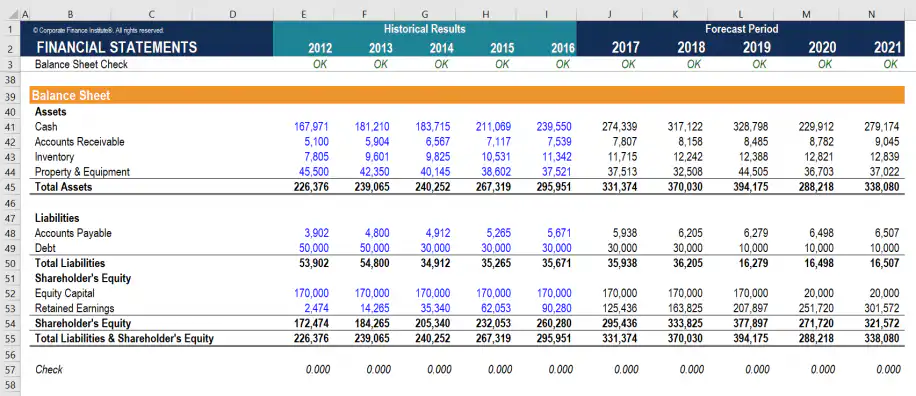
Image Source: Corporate Finance Institute
It is the most basic model in which three crucial financial statements of a company, i.e., Income Statement, Balance Sheet, and Statement of Cash Flow, are linked. These links work through formulas in a spreadsheet, modifying inputs and assumptions to drive a quick snapshot of the company’s profitability. The connections and linkages of three statements and other basic inputs and assumptions facilitate changing any input in a few seconds. It saves time and effort on establishing the model of each amendment from scratch. However, one should have strong Excel skills and command of accounting to create such connections between statements.
2. Discounted cash flow (DCF) model
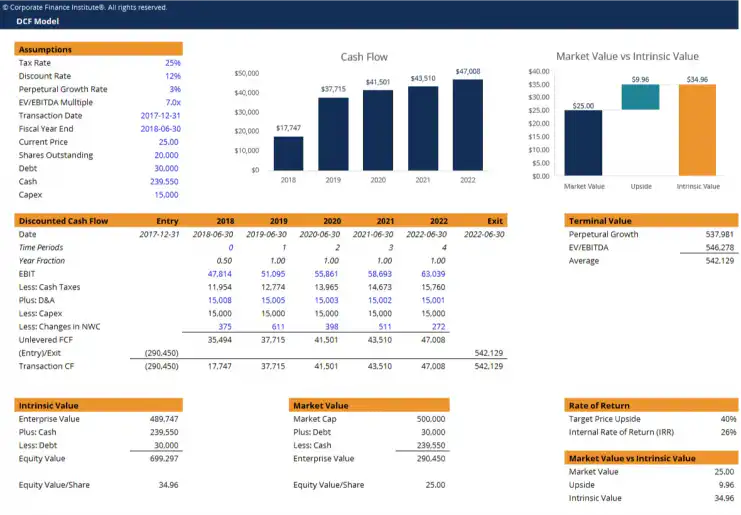
Image Source: Corporate Finance Institute
The DCF model is used to project business valuation based on the company’s forecasted future cash flows and net present value (NPV). In this model, the projected cash flows, derived from the three-statement model with a few required adjustments, are discounted back to the current date at the firm’s weighted average cost of capital (WACC) to determine the company’s present worth.
3. Mergers and acquisitions (M&A) model
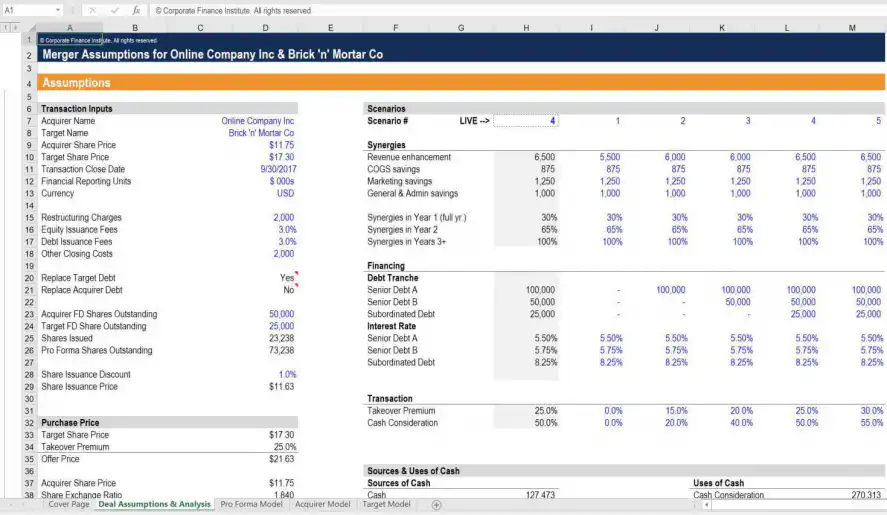
Image Source: Corporate Finance Institute
It is a common model used to evaluate the current performance of companies involved in mergers or acquisitions and the impact of mergers and acquisitions on the future performance of both companies, i.e., companies being merged, acquiring a firm, or a firm that is going to be acquired.
4. Initial public offering (IPO) model
The initial public offering is one of the critical events for the organization. Companies put efforts to analyze its impact on future performance and valuation in advance with the help of investment bankers. Investment analysts or professionals establish an IPO model on Excel to forecast the effect of IPO on business.
5. Budget model
The budget model is constructed based on monthly or quarterly figures of expenditures and earnings to design the company’s budgets. It has a high dependency on Income statements. It is used mainly by the financial planning department of the firm.
6. Comparable company analysis (CCA) model
The CCA model is comparatively simpler than the DCF model used to predict the company’s worth. It utilizes parameters of other similar businesses to determine company worth, assuming that companies with similar sizes and operating in the same industry have similar multiples. Enterprise Value to Sales (EV/S), Price to Earnings (P/E), Price to Book (P/B), and Price to Sales (P/S) are the most frequently used multiples.
7. Consolidation
Corporations that own various business units execute models for each business unit and then cumulate results of the individual section in the consolidated picture of the entire corporate. It can help a company analyze which sectors are strengthening its position and which units are weakening it.
Financial modeling limitations
As mentioned earlier, modeling efficiency depends on the reliability and accuracy of source data and assumptions. Using incorrect information and unrealistic and irrelevant assumptions can lead to inaccurate projections and impact a company’s decisions.
Financial modeling requires strong accounting understanding and Excel skills. Misunderstanding of concepts can also yield under or overstated estimates. Moreover, high dependency on terminal value to determine the net present value (NPV) and weighted average cost of capital (WACC) can also be considered a limitation of financial modeling. Considering a longer time frame can also cause difficulty and complications; therefore, executing the model for the short term is recommended by analysts.
Furthermore, the models provide numerical information; however, it is equally important to consider qualitative factors to make any business decision. Several mergers and acquisitions failed due to subjective or soft factors, e.g., issues faced while integrating two companies’ cultures.
Financial forecasting
Financial forecasting is a vital part of business planning, budgeting, and operations management. Financial forecasts represent the company’s projected cash flows throughout the accounting period, considering the trend of internal and external historical data to provide essential information about the firm’s financial performance at some time in the future.
Financial forecasting significance and implication
Forecasting is essential for accountants as:
- It provides a picture to plan cash flows to pay off liabilities
- It gives information to generate a reasonable budget and its allocation
- The decision about how much to invest in capital expenditure is made easier
- Entrepreneurs need to propose their start-up business plans to potential investors.
Financial forecasting methods
There are various financial forecasting methods:
1. Straight-line method
It is the most basic approach of forecasting, where planners utilize historical data and curves to anticipate the growth of earnings for a specified time.
2. Moving average
It uses recurrent forecasts to build projections based on previous performance and trends. Generally, these forecasts are developed for three months and five months.
3. Simple linear regression/multiple linear regression
The simple linear regression method includes analysis of the relationship between independent and dependent variables. This linear regression model exhibits the impact on dependent variables in the form of graphical representation showing trends that can be utilized to evaluate financial parameters such as profits, sales, revenue, and share prices. The rising upward trends indicate positive performance, whereas downward trends display negative performance. Corporations may use the multiple linear regression method in more complex and complicated scenarios involving multiple independent variables.
4. Time series
The time series method includes figures from certain time intervals to anticipate future performance. This method is generally used for short-term views, for example, predicting revenue based on the last seven months’ revenue growth.
Financial forecasting limitations
Similar to financial modeling, financial forecasting also relies on historical data and assumptions. Forecasting also has a high reliance on forecasting techniques. One of the main limitations for financial planning and forecasting is uncertainty associated with factors and the future. Drastic amendments in the external environment, e.g., legal and economic changes, can adversely affect the financial forecast.
Financial modeling vs. financial forecasting
Similarities
Both financial models and forecasts are crucial for professionals and analysts, and both have some common characteristics.
- Financial models and forecasts have the common objective of predicting the company’s future worth and performance based on historical expenses and incomes and presumed future parameters.
- Both utilize similar data and projections for variable costs and revenues.
- Both models and forecasts are used by similar audiences, i.e., investors, analysts, lenders, stakeholders, corporate planning, and budgeting teams.
Differences
While financial modeling and forecasting share similar characteristics, they still differ in the following aspects.
- A financial forecast is the representation of estimated cash flows for a specific period. In contrast, a financial model is an analytical tool that enables evaluating the impact of cash flows and other factors on a company’s performance and value.
- A financial forecast is built for a specific period, whereas a financial model is built to achieve a particular objective or for a specific reason.
- Forecasts are used regularly to facilitate planning and budgeting. However, financial models are constructed to make significant and vital business decisions.
Conclusion
Financial modeling and forecasting are essential tools for planners and corporate finance professionals that enable businesses to forecast future projections and estimate business worth based on historical data. Analysts use various models and methods to achieve their objectives and make crucial business decisions such as where to invest money and how to raise funds.
To build a forecast in a spreadsheet, start with our guides to revenue forecasting and the FORECAST function in Google Sheets. Once the period closes, budget variance analysis shows how far the actual results moved from the plan. And if your finance team builds its models from many spreadsheets, Sheetgo’s AI finance virtual employee can take on much of the routine work of gathering and updating that data.


 English
 Español
 Português do Brasil
 Français