




Growth rate is a very important variable for any business. However, it is a broad concept that can be measured and calculated using different metrics and methods. For example, the company’s Internal Growth Rate (IGR) and its Sustainable Growth Rate (SGR) are both calculated based on specific assumptions regarding capital funding. While IGR only considers internal funding, SGR accounts for the current capital structure, so it includes existing debt and equity capital. This makes SGR an important indicator for long-term, sustainable growth.
In this guide, you will learn about SGR and its importance in assessing a company’s long-term financial performance. You will also learn how to calculate SGR and see examples of how to apply the formula. Finally, you will learn how SGR is evaluated and how it differs from IGR.
What is a sustainable growth rate (SGR)?
Sustainable growth rate represents the maximum growth rate that a company can sustain without changes to its capital structure. In other words, it’s the maximum rate of growth that can be achieved without requiring additional financing in the form of debt or equity. The debt-to-equity ratio measures that mix of debt and equity.
Why is sustainable growth rate important?
Sustainable Growth Rate (SGR) is an important financial metric. It shows how much the company can grow without needing additional financing and helps identify the company’s current stage in the business life cycle. Creditors or lenders use this metric to assess the likelihood of the company defaulting on loan payments.
How to calculate sustainable growth rate?
To calculate a company’s SGR, you can use the following formula:
sustainable growth rate = retention rate * return on equity
The retention rate expresses the percentage of earnings that the company has not paid out in dividends, making them retained earnings. To calculate the retention ratio, you can use this formula:
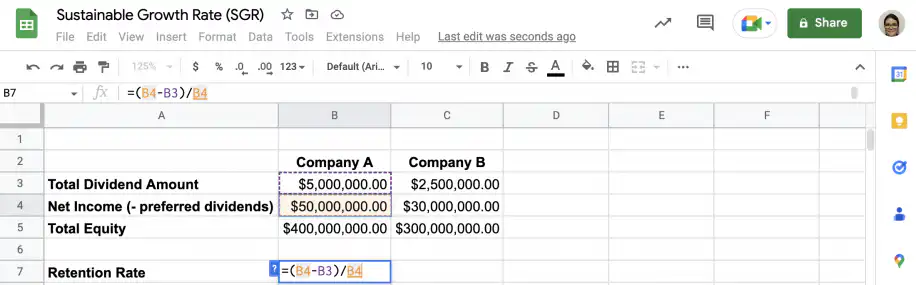
retention rate = (net income – dividends) / net income
The retention rate can also be calculated as follows:
retention rate = 1 – dividend payout ratio
Return on equity, on the other hand, measures the company’s profitability relative to its shareholder equity. To calculate return on equity, you can use the formula below.
return on equity = net income / total shareholder equity
In the next section, you have examples of how to calculate SGR using Microsoft Excel or Google Sheets.
Sustainable growth rate examples
Now that you know the formula used to calculate a company’s Sustainable Growth Rate (SGR), let’s see how you can use Microsoft Excel or Google Sheets to calculate it.
1. Gather data
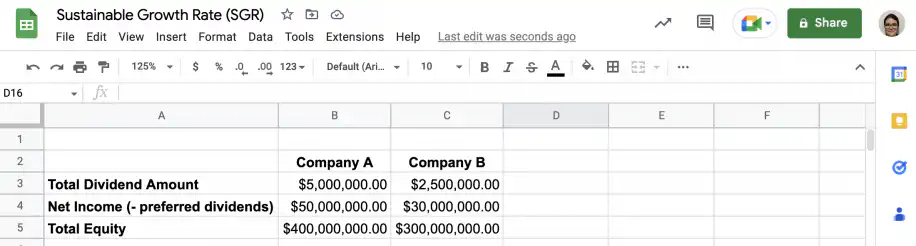
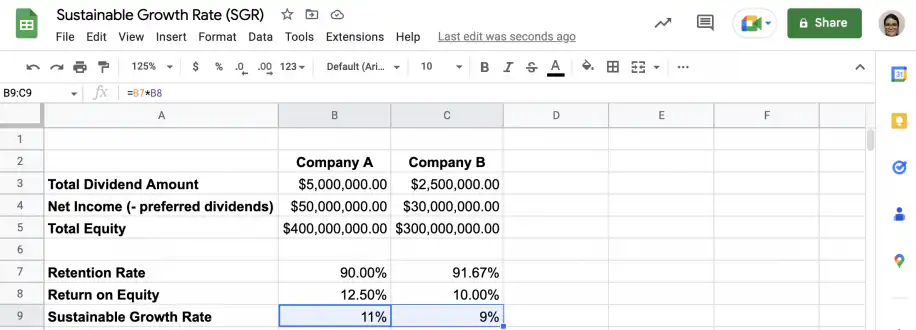
The first step is to gather the required data in your spreadsheet: net income, total shareholder equity, and the amount paid out in dividends. The screenshot below shows the relevant data for Company A and Company B.
2. Calculate retention rate
In an empty cell, type the equal sign and add the retention rate formula using cell references.
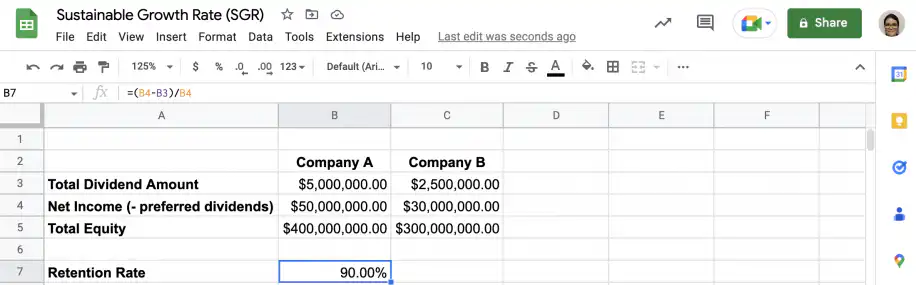
Press ‘Enter’ to see the retention rate.
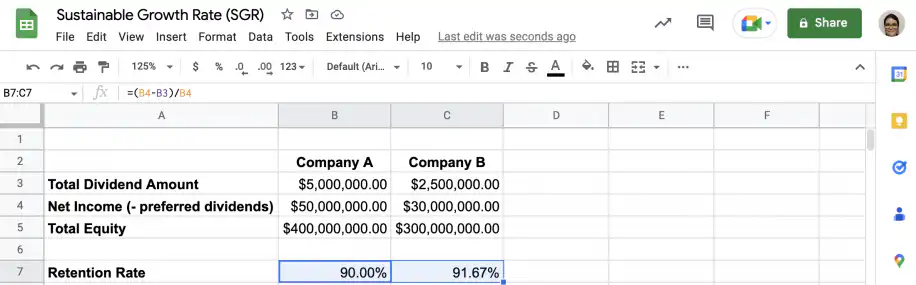
Grab the fill handle and drag right to get the retention rate for Company B.
3. Calculate return on equity
Now that you have the retention rate, you need to calculate the return on equity. In an empty cell, type in the equal sign and add the formula using cell references.
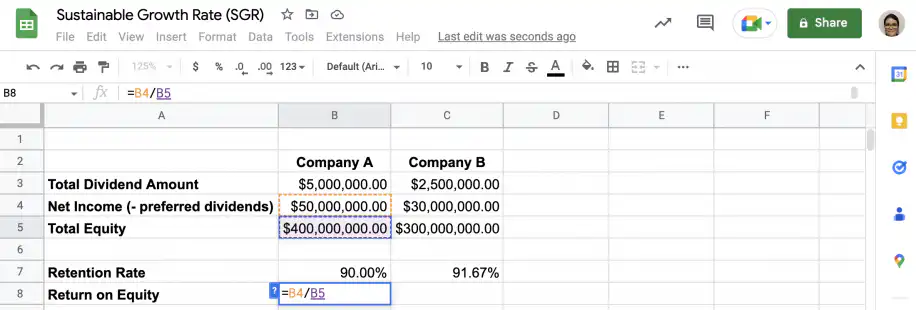
Grab the fill handle and drag right to get the return on equity for Company B.
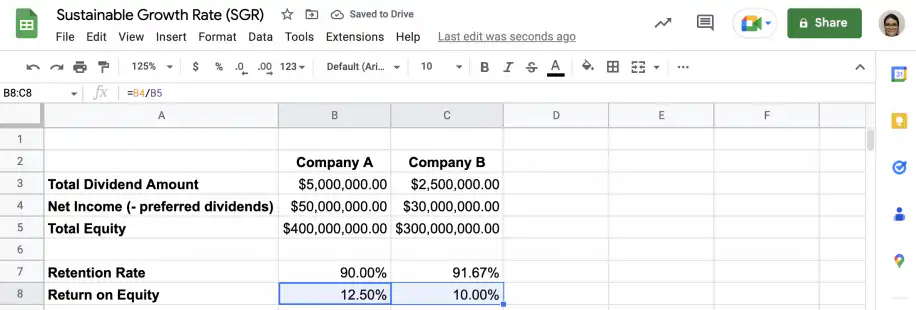
4. Calculate sustainable growth rate
Finally, add the SGR formula in an empty cell by multiplying the retention rate by the return on equity.
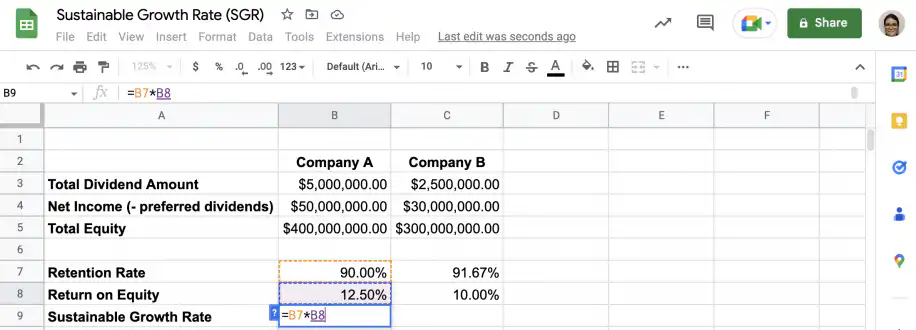
Press ‘Enter’ to see the sustainable growth rate.
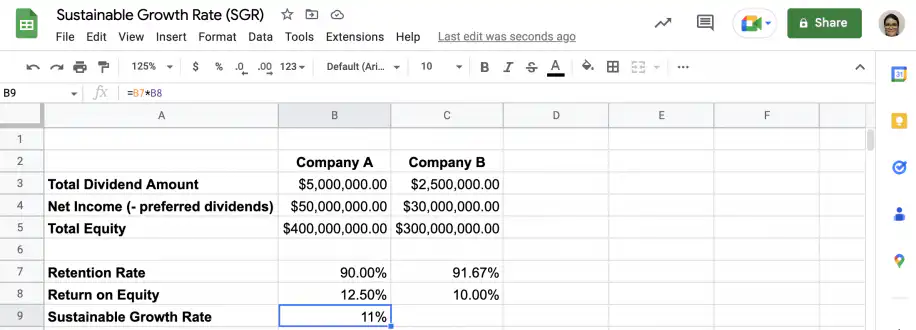
Grab the fill handle and drag right to get the sustainable growth rate for Company B.
What is a good sustainable growth rate?
The acceptable range of values for the Sustainable Growth Rate (SGR) depends on various factors. Generally speaking, the higher the SGR, the better. Higher SGR values are usually indicative of the early stages of the business life cycle. However, a high SGR is very difficult to maintain in the long run.
What is sustainable growth rate vs. internal growth rate?
Sustainable Growth Rate (SGR) is the company’s maximum growth rate considering its current debt and equity financing but assumes the current mix will remain unchanged. Internal Growth Rate (IGR), on the other hand, is more restrictive and considers only internal funding or retained earnings.
Conclusion
As you have seen, Sustainable Growth Rate (SGR) is an important financial metric with multiple uses. Investors, lenders, and the company itself can all use this metric to assess long-term growth potential. Investors can use it to assess the attractiveness of different investment opportunities, while lenders can use it to estimate the likelihood that the company will default on loan payments. Companies can use it to plan long-term growth, project cash flows, and evaluate the limitations of their current capital structure.
You now know what Sustainable Growth Rate (SGR) means, why it’s important, and how it differs from Internal Growth Rate (IGR). You also know the formula for SGR and how to calculate it using Excel or Google Sheets.
To learn more about another technique used to evaluate company growth, check out our guide on the SaaS Rule of 40.
For a simpler growth measure, see how to calculate year-over-year growth. If net income, dividends, and equity figures live in separate spreadsheets, Sheetgo’s AI finance virtual employee can collect them and keep your SGR calculation up to date.


 English
 Español
 Português do Brasil
 Français