
Get help

Help center

Guides and answers

Contact support

Write to our team

Sign in to

Workflows

Build processes with your team

Automations

Connect files and automate tasks

One system, four parts

AI agents

Virtual Employees that work 24/7

Automations

Connect files and automate tasks

Workflows

Build processes with your team

Data Space

Trusted data sharing and control

Solutions by department

Finance

Reports, budgets, and reconciliations

Inventory and manufacturing

Stock, orders, and production in one view

HR

Timesheets, attendance, and reviews

Project management

Status and workload across projects

Sales and CRM

Leads and deals kept up to date

Education

Student records and school data

Finance

Turn manual finance work into reports that update themselves.

What Finance teams automate

  • Track payables and receivables
  • Build cash flow statements
  • Compare budget against actuals

Inventory and manufacturing

See stock levels and automate ordering.

What inventory and manufacturing teams automate

  • Track inventory across multiple sites
  • Connect sales, purchasing, and warehouse data
  • Link a barcode scanner to your sheet

HR

Run recruitment, attendance, and OKR tracking from your sheets.

What HR teams automate

  • Track recruitment and onboarding
  • Record team OKRs and results
  • Track check-ins, check-outs, and leave

Project management

Assign tasks and track hours without manual updates.

What project teams automate

  • Assign tasks and track status changes
  • Estimate effort and log hours worked
  • Track milestones across projects

Sales and CRM

Track leads and sales performance with automated reports.

What sales teams automate

  • Track and convert leads
  • Set sales goals and track team metrics
  • Monitor sales KPIs on dashboards

Education

Automate attendance, grades, and school purchasing.

What schools automate

  • Track attendance and notify parents
  • Record and compare class grades
  • Track inventory lent to students and staff

Find a use case

By department

How each team uses Sheetgo

By industry

How each industry uses Sheetgo

By company size

Small, medium-sized, or large

Learn

Blog

Guides and product news

Customer stories

How teams like yours use Sheetgo

Help center

Guides and answers

Why Sheetgo

Compare

How Sheetgo compares with other tools

Security

How we protect your data

Trust center

Our compliance details

Sign in to

Workflows

Build processes with your team

Automations

Connect files and automate tasks

One system, four parts

AI agents

Virtual Employees that work 24/7

Automations

Connect files and automate tasks

Workflows

Build processes with your team

Data Space

Trusted data sharing and control

Solutions by department

Finance

Reports, budgets, and reconciliations

Inventory and manufacturing

Stock, orders, and production in one view

HR

Timesheets, attendance, and reviews

Project management

Status and workload across projects

Sales and CRM

Leads and deals kept up to date

Education

Student records and school data

Find a use case

By department

How each team uses Sheetgo

By industry

How each industry uses Sheetgo

By company size

Small, medium-sized, or large

Get started

Templates

Ready-made workflows to start from

Learn

Blog

Guides and product news

Customer stories

How teams like yours use Sheetgo

Help center

Guides and answers

Why Sheetgo

Compare

How Sheetgo compares with other tools

Security

How we protect your data

Trust center

Our compliance details

Help center

Guides and answers

Contact support

Write to our team

Workflows

Build processes with your team

Automations

Connect files and automate tasks

How to indent in Google Sheets (+ examples)

Despite being a spreadsheet program, Google Sheets provides many features related to text formatting. However, you may have noticed it lacks some basic features related to text, such as the ability to insert bullet points or use the tab key to indent contents within your cells. Fortunately, while there’s no button or menu option, there are multiple ways to do both.

In this guide, you will learn about four different methods you can use to indent the contents of your cells. The first method uses the copy & paste technique, which allows you to get tab spacing from other programs. The second method uses the custom number format feature to display an indentation in your cell contents. The third method uses the always useful CHAR function to indent contents with a formula. Finally, the fourth method uses a helper column to give the appearance of indentation without changing the cell’s contents.

Can you tab within a cell to indent in Google Sheets?

Unfortunately, you can’t use the tab key to indent cell contents, as you will simply move to the next cell. However, you can type multiple spaces before your text or copy a tab space from another program, such as TextPad or Google Docs, and paste it directly into your cell.

Indent in Google Sheets with a custom number format

Select the cells to which you want to apply the indentation and go to Format > Number > Custom number format. In the text box at the top, type in the spacing you want to indent by, followed by the at symbol (@). Click ‘Apply’ to save and apply the indentation.

1. Select the cells to which you want to add the indentation and go to Format > Number > Custom number format.
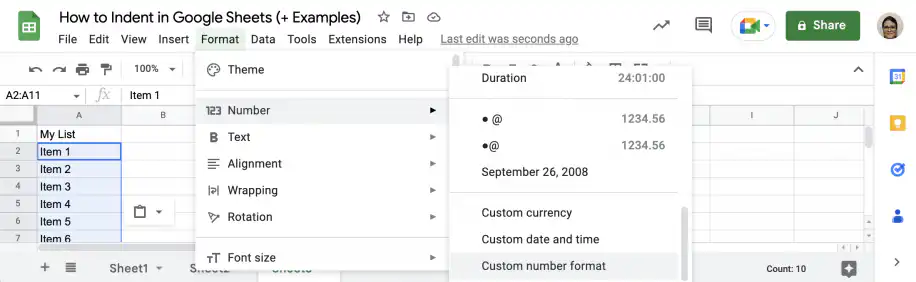
How to indent in Google Sheets — Format menu open at Number with Custom number format at the bottom

2. In the text box, add as many spaces as you need to achieve the indentation you want, followed by the at symbol (@). Pasting a tab space in this text box won’t work, so you must use the space key.

Indent in Google Sheets — Custom number formats dialog with spaces typed before the @ symbol

3. Click ‘Apply’ to save and apply the custom number format.
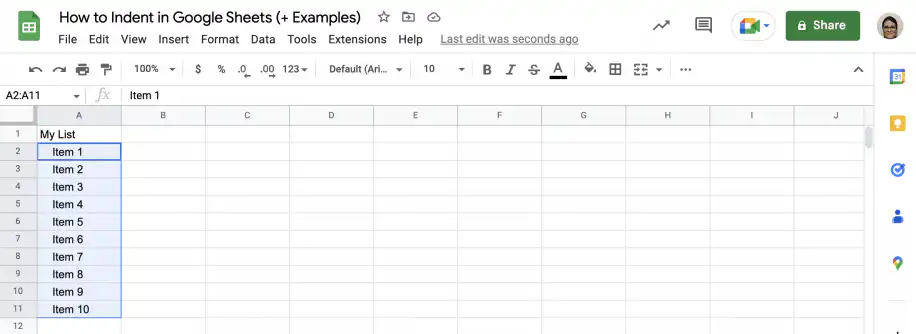
Indent in Google Sheets — list items in column A indented by the custom number format

Indent in Google Sheets with a formula

In Google Sheets, you can indent the cell’s contents by using the CHAR function in your formulas. CHAR(32) will insert a space within your formula, so if you want to indent the contents, you can add as many spaces as you need before the values or calculations you want to indent.

1. In an empty cell, type the equal sign followed by CHAR(32). If you want to use more than one space character, you can concatenate them using the ampersand (&), as shown below.
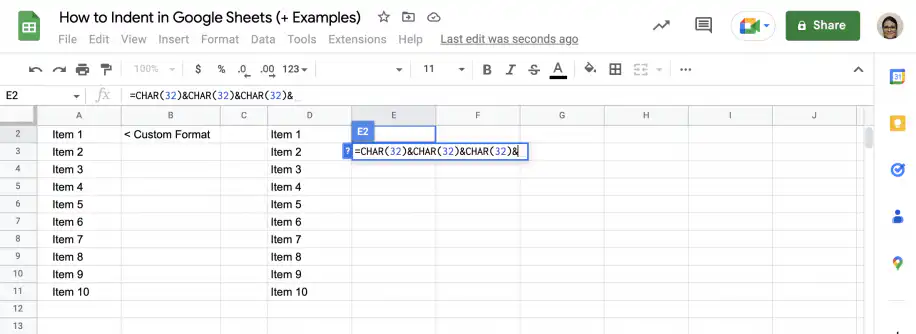
Indent in Google Sheets with a formula — CHAR(32) joined three times with ampersands in cell E2

2. After the last ampersand (&), type the text between quotes, the value, or the calculation you want to use. Alternatively, select the cell with the contents, as shown below.
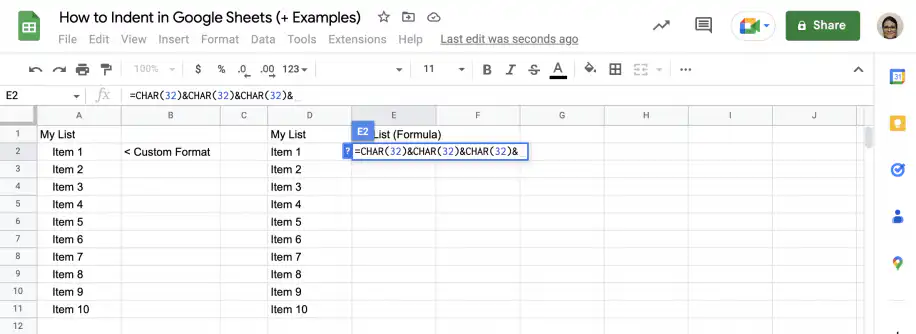
Indent in Google Sheets with a formula — cell D2 added after the CHAR(32) spaces in the formula

3. Press ‘Enter’ to see the result. Grab the fill handle and drag it down to the last item.
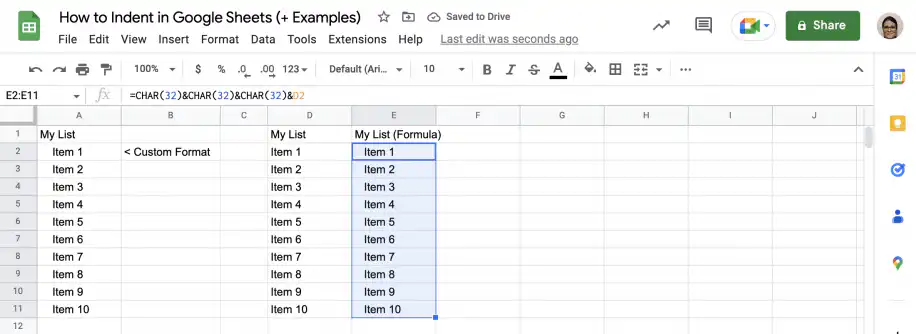
Indent in Google Sheets with a formula — indented list filled down column E under My List (Formula)

Indent in Google Sheets with a helper column

This last method won’t add the indentation within the cells but simply use a helper column to give the appearance of indentation. In other words, you can make it look like the entire column’s contents are indented.

1. Insert a column to the left of the one you want to indent.
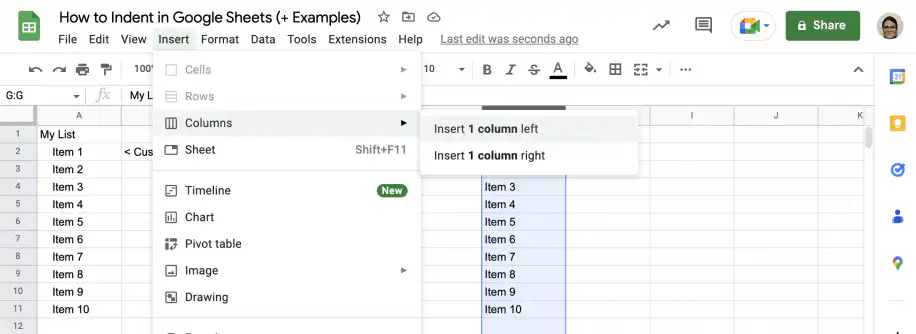
Indent in Google Sheets with a helper column — Insert menu at Columns with Insert 1 column left

2. Resize the helper column to the width by which you want to indent.
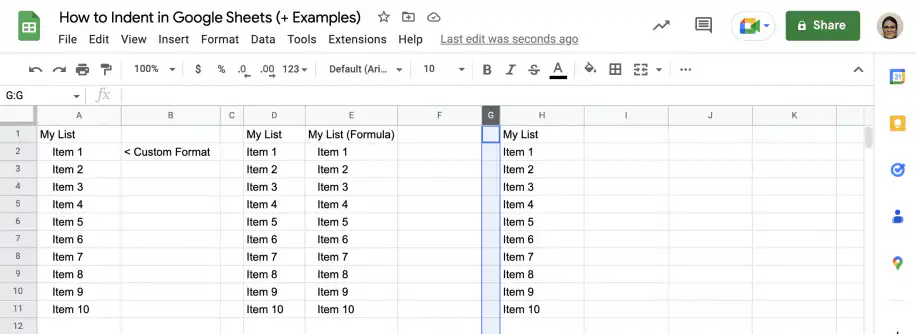
Indent in Google Sheets with a helper column — narrow empty column G resized next to the list

3. Select the first cell in both columns and merge them using the button on the toolbar.
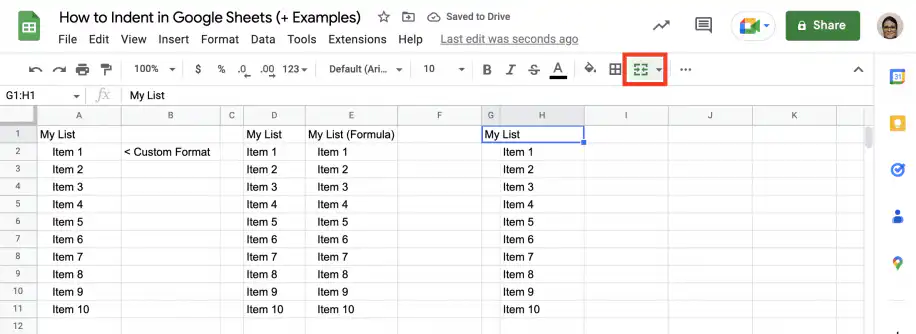
Indent in Google Sheets with a helper column — cells G1 and H1 selected with the merge button highlighted

4. As you can see, the contents of the column on the right appear to be indented. However, the gridlines are still visible.
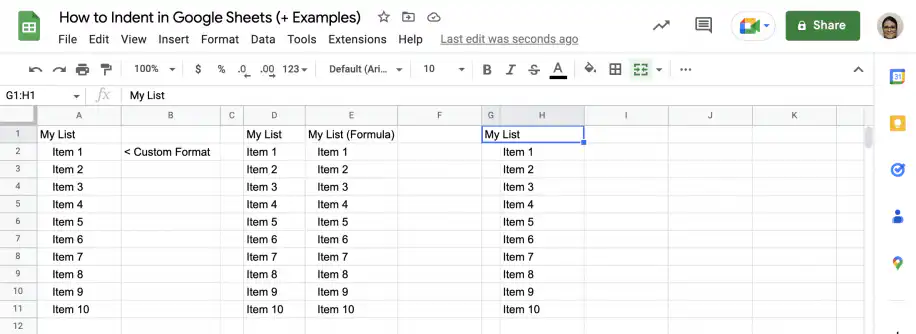
Indent in Google Sheets with a helper column — list appears indented with the gridlines still visible

5. To remove the gridlines in the spreadsheet, select the relevant cells in both columns and click on the border button in the toolbar. Change the color to white, as shown below.
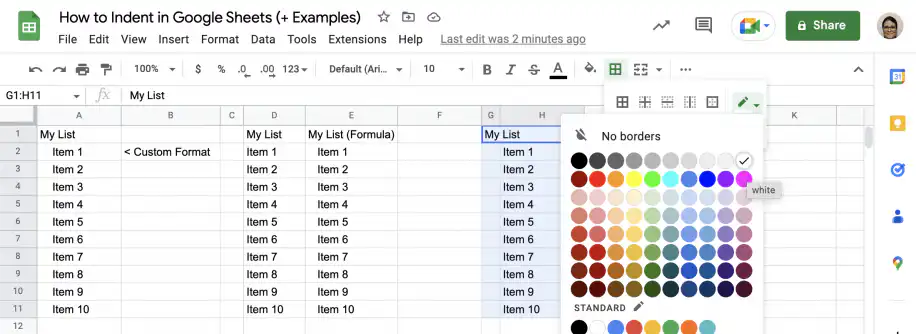
Indent in Google Sheets with a helper column — border color palette open with white selected

6. Select ‘Inner borders’ from the toolbar drop-down menu.
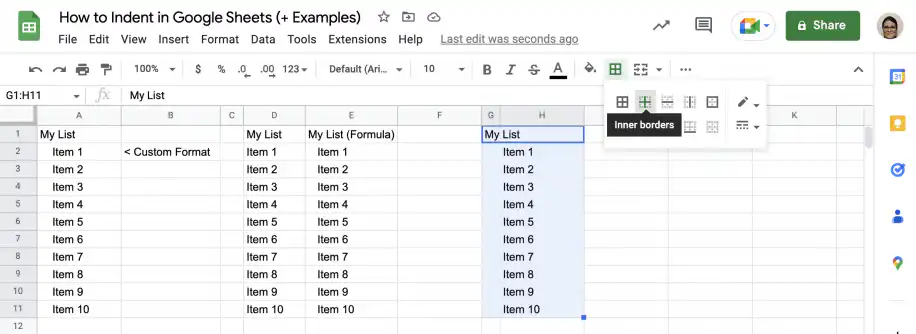
Indent in Google Sheets with a helper column — borders menu with the Inner borders option

7. Reselect the cells in both columns and change the color to black.
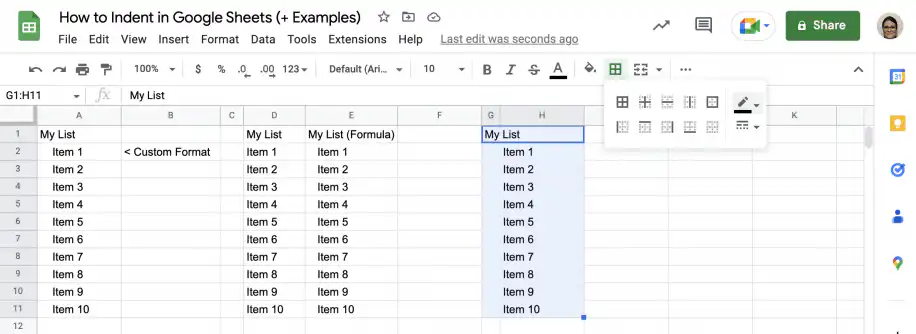
Indent in Google Sheets with a helper column — borders menu reopened with the border color set to black

8. Select ‘Outer borders’ and ‘Horizontal borders’ to apply.
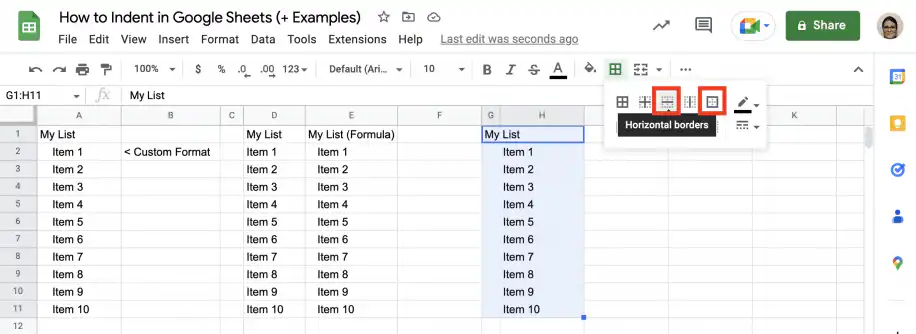
Indent in Google Sheets with a helper column — Outer borders and Horizontal borders highlighted

9. That’s it. Your indented list is ready.
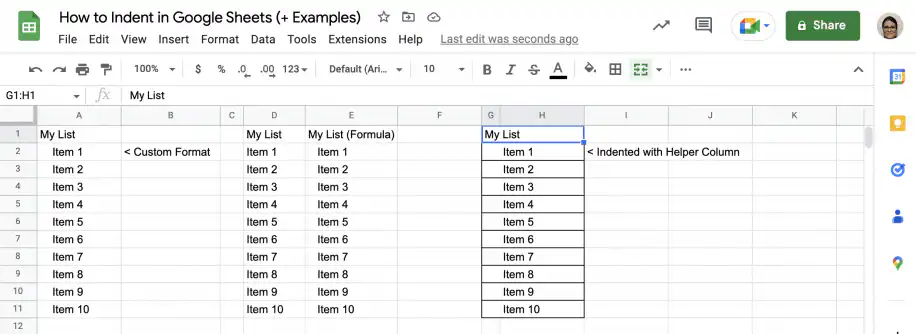
Indent in Google Sheets with a helper column — indented list in column H with black borders and no inner gridlines

How to remove indentation in Google Sheets

Since indentation is not a built-in formatting option, removing it is not always as simple as going to Format > Clear formatting. If you added it by typing spaces into the cell, you must delete it manually or use the TRIM function to remove the leading spaces. If you used CHAR(32) in a formula, you must delete that part of it. Finally, if you used the helper column method, you can simply delete the helper column.

Conclusion

While you can’t use the tab key to indent the contents of your cells in Google Sheets, many alternative methods are available. You now know how to use each method to meet different indentation needs. The quickest method for adding indentation to your cell contents is the custom number format, but you also know about a few other methods.

If you want to add indentation to existing content, you can type space characters manually or use the copy & paste method. This can be tedious and time-consuming if you have many cells to edit, but in that case, you can also use the helper column or cells method instead.

If you want to add indentation to new cells or don’t mind recreating the cells and pasting over the original cells, you know how to use CHAR(32) with the ampersand symbol (&) to indent text, numbers, or calculations. Finally, you also know how to remove the indentation added through any of the methods shown in this article.

You may also like…

google sheets features and formulas

Top 5 dynamic array formulas in Google Sheets 

Google Sheets has evolved beyond basic spreadsheets. With the introduction of dynamic array formulas, users can now manipulate and analyze...
google sheets features and formulas

Mastering the FILTER Formula: 4 Use Cases with Examples

The FILTER formula in Google Sheets is a versatile tool for extracting data that meets specific conditions. Unlike the QUERY formula,...
google sheets features and formulas

Unlocking the Power of SUMIF and SUMIFS in Google Sheets: 4 real-life use cases

The SUMIF and SUMIFS formulas in Google Sheets are indispensable tools for performing conditional summations. They simplify complex...