



In order to understand a company’s financial situation, it’s important to understand its financial statements. There are three fundamental financial statements that you need to be able to interpret: the income statement, the statement of cash flows, and the balance sheet. While all three contain important information, the balance sheet provides a balanced view of the company’s assets, liabilities, and equity.
In this guide, you will learn about the contents and purpose of the balance sheet and how it differs from the statements of income and cash flows. Using a sample balance sheet as a guide, you will learn how to read the line items on a company balance sheet. Finally, you’ll learn about the main methods used to analyze and interpret the balance sheet.
What is a balance sheet?
The balance sheet provides information about the company’s financial position in terms of its assets, liabilities, and equity. Unlike the statement of cash flows or the income statement, both of which cover a period of time, the balance sheet represents the company’s position on a given date.
The main purpose of the balance sheet is to provide a balanced view of what the company owns versus what it owes. This allows interested parties to evaluate the company’s financial position through different methods of analysis. For example, using the information provided on the balance sheet, you can calculate multiple financial ratios used to evaluate a company’s liquidity or a company’s leverage.
Balance sheet equation
Producing a balance sheet is not an exact science, so the contents are affected by multiple factors, including different accounting practices and requirements specific to the industry or country of operations. However, the underlying equation that drives the balance sheet is as follows.
assets = liabilities + shareholders’ equity
This equation shows the expected relationship between the three variables. In other words, the value of your assets should be equal to the sum of your liabilities and shareholders’ equity.
Sample balance sheet
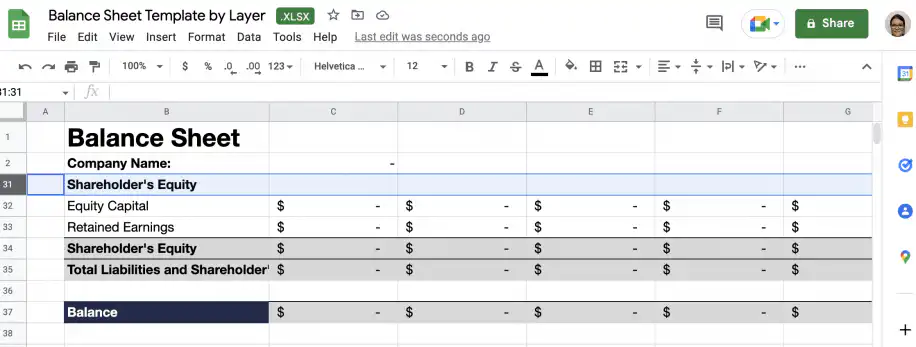
The examples in this guide come from a sample balance sheet built in Google Sheets. Each line item has its own row, each year has its own column, and every section ends with a total.
In the next section, you will learn how to read all three sections of the balance sheet, including the most common line items included in each section.
How to read a balance sheet?
The balance sheet provides an overview of the company’s financial position on a given date by showing what the company owns and what it owes. The information is structured in three sections – assets, liabilities, and equity – where the value of assets should equal the sum of liabilities and equity.
The assets and liabilities sections are further subdivided according to their status: current (short-term) versus fixed (long-term). Below, you have explanations for the line items most commonly included in each of the three main sections.
Understanding assets
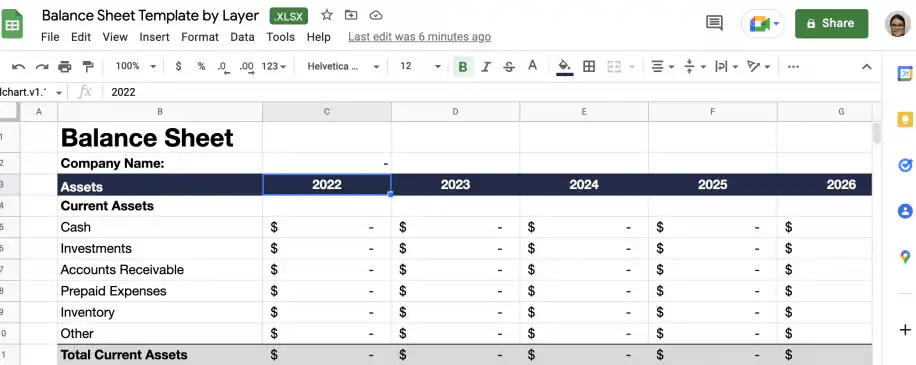
On the balance sheet, assets are subdivided into two main types. The first is ‘Current Assets’, also known as short-term assets, which are those that can be converted into cash within a year.
Current assets
This section includes the company’s most liquid assets: those that can be converted into cash quickly. Below are the three you will find on most balance sheets.
- Cash refers to hard currency, checks received, and the contents of the company’s bank accounts.
- Accounts receivable represents the amount that is owed to you by clients. In other words, it refers to the invoices you issued and will be paid within a year.
- Inventory is also considered a current asset, but it’s not quite as liquid. Depending on the circumstances, it could take a while to sell, and at a lower price.
Long-term assets
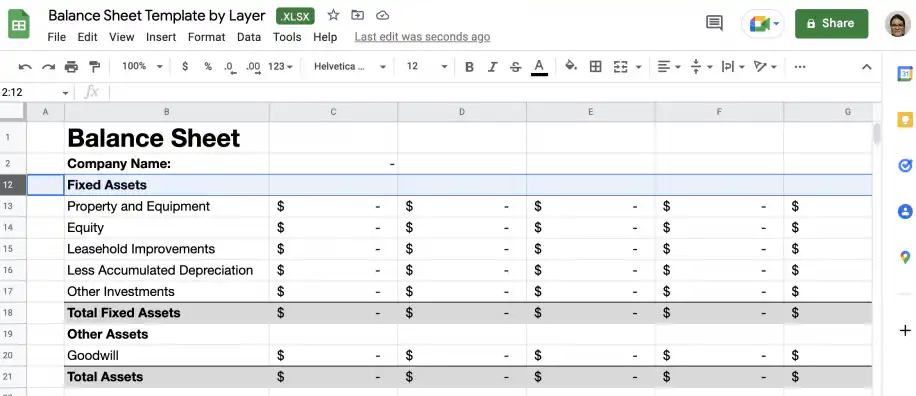
Assets that cannot be converted into cash quickly are known as long-term or non-current assets. These are then broken down further into tangible and intangible assets.
- Tangible assets include property, equipment, and land.
- Intangible assets include patents, copyrights, and goodwill.
Understanding liabilities
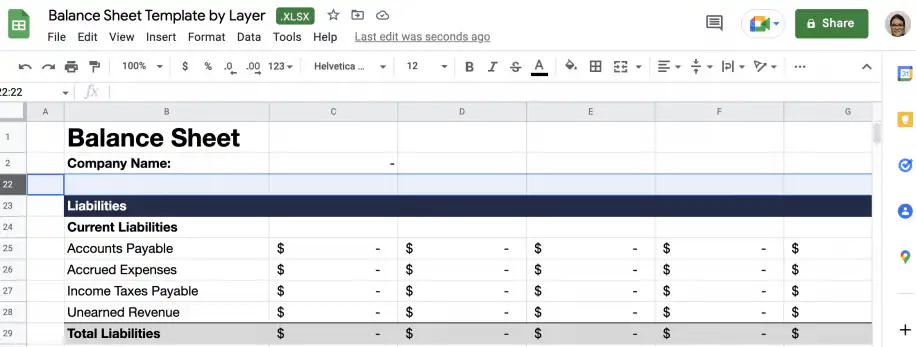
Within the section on liabilities, you will find the company’s financial obligations to third parties. Like assets, these are divided into current and long-term liabilities.
Current liabilities
Liabilities that must be paid within a year are referred to as current liabilities. These will depend on the business model and the size of the operation, but those included below are common to many businesses.
- Accounts Payable includes money that you owe, usually to suppliers or contractors, and must be paid within the year.
- Short-Term Loan Debt refers to small loans or cash advances that must be repaid within a year.
- Credit Card Debt includes all debt incurred on company credit cards.
- Interest Payments on loans that need to be paid within a year, even if the loan is long-term.
- Taxes Owed to the government, such as income taxes payable.
- Wages Owed to employees.
Long-term liabilities are obligations due in more than a year, such as long-term loans, bonds payable, and lease obligations.
Understanding equity
This section is referred to as owners’ equity or shareholders’ equity, depending on the company’s ownership structure and whether it is publicly traded. While the contents will depend on various factors, the items listed below are common to many businesses:
- Initial capital invested in the business.
- Retained earnings refer to any net earnings that are reinvested in the company instead of being paid out as dividends.
- Private or public stock issued by the company. These can be further classified as common or preferred stock.
Balance sheet analysis and interpretation
As you have seen, the balance sheet contains a lot of useful information about the company’s financial situation. Now that you know how to read it, you can get a quick picture at a glance. However, there are multiple methods of analysis that can be used to get the most out of the information on the balance sheet.
In addition to the horizontal and vertical analysis of the balance sheet, numerous financial ratios can be calculated from the data on the balance sheet, including those related to the company’s liquidity or use of leverage. Using Google Sheets or Excel, together with Sheetgo’s AI finance virtual employees, you can synchronize the data from your financial statements to automate the calculation for multiple metrics, including all kinds of financial ratios. This will save you time and effort, which can be used to analyze the results and work on financial strategy.
Conclusion
As you can see, being able to read and interpret a company balance sheet is a very useful skill. This financial statement provides a balanced view of the company’s financial position in terms of its assets versus its liabilities and equity. Moreover, you can use the data provided to generate additional information in the form of financial ratios.
You now know about the structure and contents of the balance sheet, including the most common line items for each section. You also know about various methods that you can use to analyze the balance sheet and generate even more information on the company’s finances.
To learn more about financial statements and the methods used to analyze them, check out our guides on:


 English
 Español
 Português do Brasil
 Français