




While budgets are vital in deciding the future course of action and planning a financial roadmap, not every budget is designed with all existing and anticipated conditions in mind. Zero-based budgeting is a type of accounting that focuses on creating a budget from the ground up. On the other hand, traditional budgets focus on assessing changes in operational efficiency and costs and heavily rely on previous expenditures and spending.
Budgeting on a zero-based basis focuses on calculating spending based on actual expenses rather than a differential basis. Every business action and expense is justified and proportioned against the organization’s revenue using this strategy.
In a zero-based budget, no balances are carried forward, and no expenses are pre-committed. Simply described, it is a method for creating a budget with no prior assumptions. This strategy emphasizes task identification and cost funding regardless of the present expenditure structure.
What’s the difference between traditional budgets and zero-based budgets?
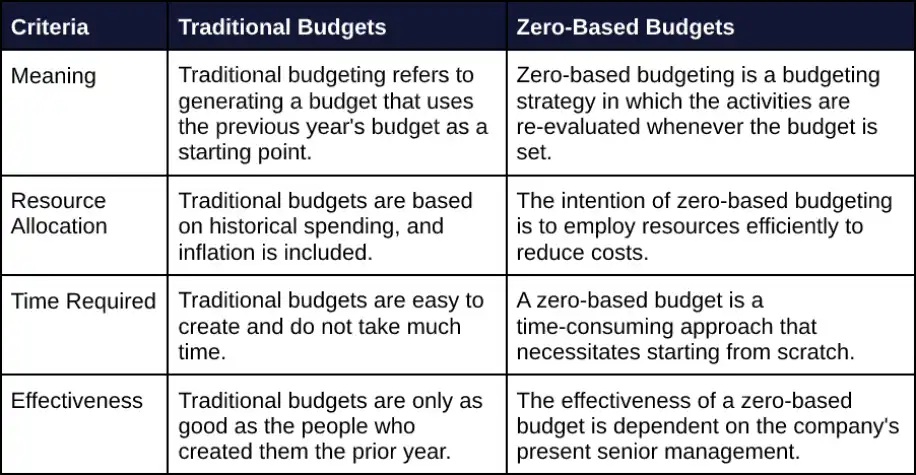
In today’s business environment, traditional budgets have become obsolete because they serve no practical purpose. The majority of allocation depends on previous costs and expenses. And, aside from becoming a simplified process, it serves no purpose for the corporation, a business, or even an individual.
However, zero-based budgeting is a budgeting method in which all expenses must be justified and approved for each new period, making it cost-effective. Furthermore, the current state of the business environment is taken into account. As a result, zero-based budgets are far superior to traditional budgets in every way.
What are the zero-based budgeting steps?
1. Identification of Decision Units: The first and most crucial stage in zero-based budgeting is identifying decision units. A decision unit can be either a particular activity or a group of related activities in some way.
An individual’s activity does not intersect with the organization’s other activities. For example, the HR department’s activities do not coincide with those of the marketing department. However, different recruitment processes overlap and may or may not require different decision units.
An organization comprises several departments, such as marketing, finance, research, and human resources. Each cost center functions as a decision unit. As a result, various departments’ overlapping activities can be consolidated into a single cost center.
As a result, the department head of each department should submit a budget based on their department’s current situation and should not incorporate the prior year’s data and expenses.
2. Apportion Decision Packages: Once the decision units have been assigned, the next step is to divide them into small-scale decision packages. Such decision packages must align with the overall corporate goals.
Every decision package should include all essential details that can aid in determining the amount of funding required. These include things like functions, goals, economic benefits, intangible benefits, and how funds will be used for operations, among other things.
An ideal decision package should include the following details:
Analyzing the task and its finer points.
A detailed analysis of the technical and operational feasibility of the task.
The aims and objectives of a larger decision unit.
Alternate path of action and needed funding.
3. Ranking the Decision Packages: All of the identified decision packages should be prioritized and rated based on their potential impact—this ranking aids in the efficient use of resources, which leads to a cost-benefit analysis.
However, all alternatives must be examined. Senior management must guarantee that the decision package is accurate, realistic, and error-free while ranking the decision packages.
4. Allocation of Funds & Resources: The funds are awarded in this step based on rankings and priority. As a result, the highest-ranked choice package receives more funds, and cost-effectiveness is considered.
5. Assessment & Control: The next step is assessment and control, which involves monitoring and evaluating the performance and output of all decision packages.
Assessing the effectiveness of decision packages supports management in identifying whether resource allocation is being done effectively or whether previous decisions should be changed.
What are the advantages of zero-based budgeting?
Increased Efficiency: Real-time spending is considered in zero-based budgeting, and historical numbers have no meaning.
Clarity on Operations & Cash Flow: A zero budget provides transparency into how much money is coming in and going out of the business. It also aids in the planning of activities so that funds and operations can be readily tracked and managed.
Increased Accuracy: Unlike traditional budgeting approaches, which entail making discretionary modifications to the previous year’s budget, zero-based budgeting requires each department to examine every working capital item and calculate its operation costs. It aids in cost reduction by providing a clear image of the expenses as opposed to intended performance.
Optimization of Business Processes: Streamlining spending and concentrating on things that directly generate wealth for a company through increased value, increased productivity, economies of scale, and so on, promotes long-term improvement.
Strategic Growth & Transparency: With a strong emphasis on warranted expenditure and spend integration with organizational goals, zero-based budgeting encourages CFOs and other top-level management to introduce straightforward, fascinating budget interpretations and exemplify growth, profit margins, and competitor effectiveness of the business as a whole.
What are the disadvantages of zero-based budgeting?
- Time-Consuming Process: Time restrictions are a huge concern, with financial teams working both figuratively and physically to coordinate across business units to ensure all budgets are properly planned throughout the budgeting process.
- Complex and Expensive: Unlike standard budgeting systems, zero-based budgeting can be expensive and difficult to adopt. The additional training required (including the use of any new software, procedures, etc.) and the fact that each budget is constructed from scratch rather than relying on the faster and more accessible data from the previous year can add a significant price when making a move.
- Disruptive: Making the switch to zero-based budgeting can be both mentally and cognitively challenging for some people. CFOs may struggle to adjust, prioritize and rationalize every item in their budget, resulting in pushback that must be addressed before they can function at complete efficiency.
Zero-based budgeting example
Bingo Corp. is a giant pharmaceutical company located in Dallas, Texas. Earlier, they used to manufacture all the ingredients for their drugs in their laboratories. In addition, they used traditional budgeting techniques to ascertain various costs and expenses.
However, costs associated with the manufacturing of ingredients keep getting higher as time goes on. Hence, a zero-based budgeting model can help the company look for other alternatives for the ingredients and determine whether it can cut down its costs through a cost-benefit analysis, thus starting the estimation from scratch and finally arriving at a conclusion.
Conclusion
According to Accenture, companies that have effectively used zero-based budgeting were able to realize 18% savings and a 20% gain in share price. As a result, firms such as Mondelez International, Campbell Soup Company, Kraft Heinz, Anheuser-Busch InBev, and Tesco have been public about adopting zero-based budgeting tools in earnings calls.
Hence, zero-based budgeting attempts to determine the correct expenses generated by the company based on needs and preferences. Therefore, zero-based budgeting can help with cost minimization and adds clarity to the budgeting process. It aids in establishing appropriate targets, which can lead to extraordinary business performance and operational efficiency. Therefore, although zero-based budgeting is a time-consuming exercise, it is the most correct and acceptable budget planning method. It also increases ownership and responsibility in the organization across all multidisciplinary departments.
All budget amounts must be justified in zero-based budgeting before they may be accepted. Zero-based budgeting aims to identify possibilities, increase budgeting efficiency, and decrease wasteful expenses and prices. It is the principle of allocating the appropriate amount of money to the relevant activity. It, therefore, leads to a better allocation of the organization’s expenditures to the most critical activities that can yield the intended results. It is a forward-thinking approach to budgeting.
To try zero-based budgeting on your own numbers, start from this budgeting template and compare each period’s plan with real spending in a budget vs. actual analysis. If you’re still deciding who builds the numbers, read our guide to top-down vs. bottom-up planning. For the recurring work, Sheetgo’s AI finance virtual employees can pull each department’s spending from your spreadsheets and keep the budget up to date.


 English
 Español
 Português do Brasil
 Français