




There are many costs associated with running a business, and if you want that business to stay alive, you need to keep track of all of them. You also need to be aware of the differences between fixed and variable costs, as they play different roles in your company’s finances. While there may be some wiggle room regarding lowering certain variable costs – for example, you may find vendors that charge less for the raw materials – fixed costs tend to be more difficult to decrease. The amount you pay for rent, for example, is unlikely to go anywhere but up.
In this article, you will learn about fixed costs and how to find fixed costs from total costs and total variable costs. You will also learn how to calculate the fixed cost per unit and the average fixed cost. Additionally, you will learn how to use Google Sheets to calculate the fixed cost per unit and average fixed costs.
What is fixed cost?
Fixed costs are those not directly associated with production. They are sometimes referred to as indirect or overhead costs. Unlike variable costs, they remain fixed regardless of production level. Common fixed costs include rent, licenses, and permits. You may not need them directly for production, but your business can’t run without paying for these fixed costs.
Salaries are a good example of a cost that is frequently considered fixed. However, in some cases, parts of the salary may be variable costs – like bonuses or commissions – which are affected by increased or decreased production. In these cases, the total amount paid out as salaries can be considered a semi-fixed or semi-variable cost, as it has both components. It’s important to identify these costs and divide them into fixed and variable components.
Whether you produce thousands of units of your product or none at all, fixed costs won’t change. This makes the total fixed cost and the average fixed cost important metrics to consider when evaluating a company. Fixed costs have to be covered even when production and sales are at a minimum, so you need to keep a close eye on them.
How do you calculate fixed cost?
Total fixed costs can be calculated by adding up all fixed costs for a given period. They can also be calculated by subtracting variable costs from total costs. The fixed cost formula looks like this:
Fixed costs = Total costs – Variable costs
Depending on the number of products made by your company, you will need to calculate a few other metrics associated with fixed costs. For example, you’ll need to calculate the total fixed costs for a given period to find the average fixed costs.
How to find total fixed cost?
There are different methods that can be used to calculate total fixed costs. The first is to go through your records, making a note of all costs not directly related to making your product and adding them up.
If you already know the total variable costs for a given period, you can subtract them from the total costs for that period to find the total fixed costs. The total variable costs can be calculated by multiplying the variable cost per unit by the total number of units made.
Total fixed costs = Total costs – (Variable cost per unit * Total number of units)
How to find average fixed cost?
While fixed costs are not directly related to production, for accounting purposes, it’s useful to assign a proportion of these costs to each unit of output: the average fixed cost. Use the average fixed cost formula to calculate it for a given period.
Average fixed costs = Total fixed costs / Total number of units made
If your company makes multiple products, you need to ensure that your total number of units includes all products.
Since these calculations need to be repeated periodically, it makes sense to set up a template in Google Sheets or Excel to speed up the process. The next section includes examples that have been done using Google Sheets. If you work in a team and have cost data spread out over different files, you can use Sheetgo’s AI automations to connect those files and update your calculations automatically.
Fixed costs examples
Company X’s accounting team is working on fixed costs. They want to calculate their total fixed costs for break-even analysis, but they also want to know their average fixed costs. For this example, calculations will be based on the previous month’s costs.
Step 1: identify all fixed costs
Either of the methods mentioned in the previous sections can be used to find fixed costs. Company X can go through the expense records adding up all the costs that aren’t directly related to production. However, if they know their total costs and their total variable costs, they can use that instead.
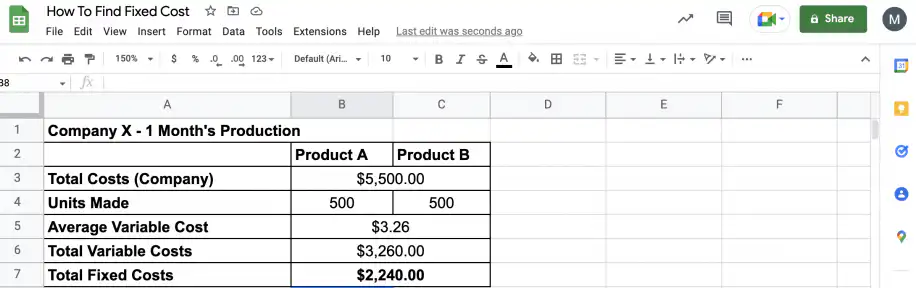
1. In Sheets, type in the values you need: total costs and variable costs for the month.
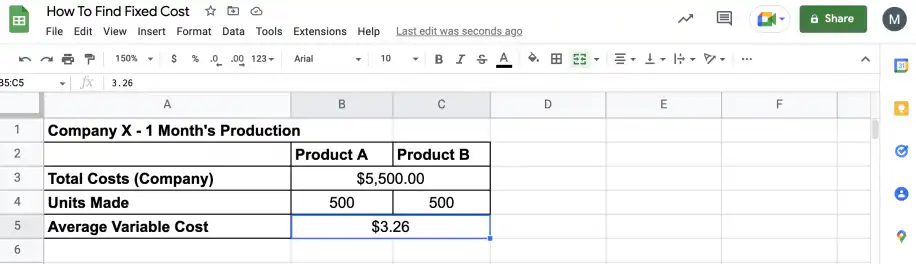
2. You can calculate total variable costs by multiplying the variable cost per unit by the total number of units made that month.
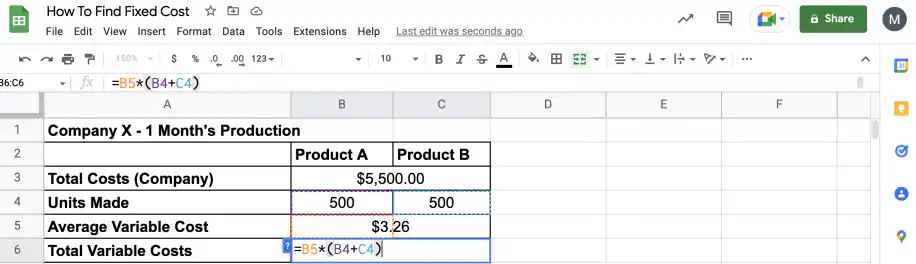
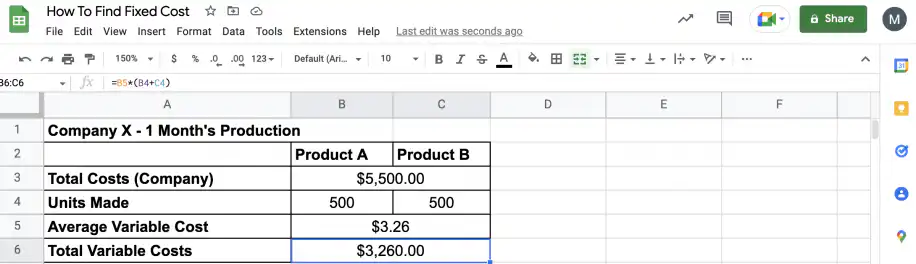
3. The total variable cost for the month is $3,260.
Step 2: calculate total fixed costs
Now, you just need to apply the fixed cost formula.
1. Subtract the total variable costs from the total costs.
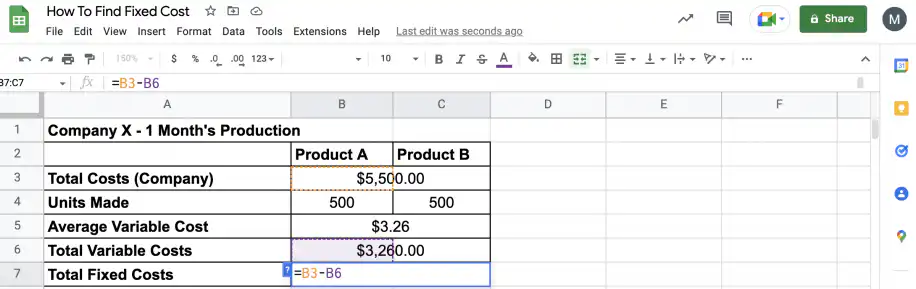
2. The total fixed cost for the month is $2,240.
Step 3: calculate average fixed costs
Now that you know the total fixed cost, calculating the average fixed cost is easy.
1. Divide the amount for total fixed costs by the total number of units made of both products.
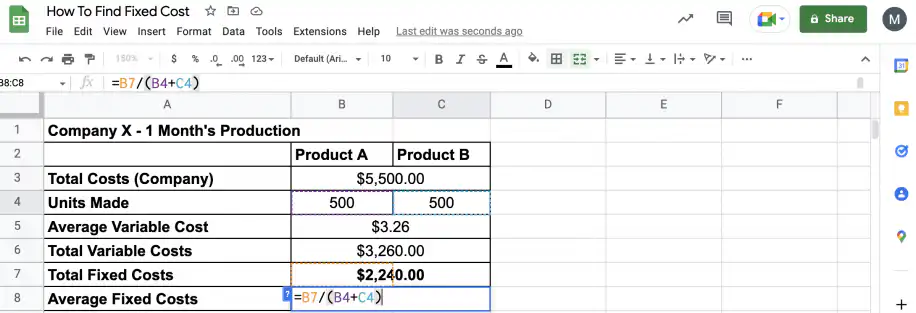
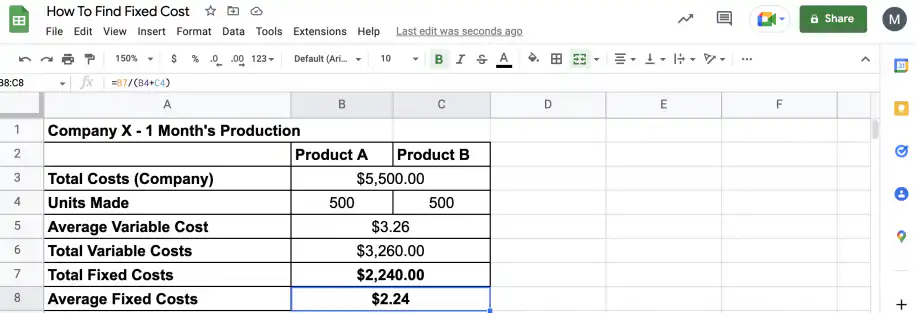
2. That’s it. The average fixed cost for Company X is $2.24.
Conclusion
Keeping accurate and detailed records of all costs is an important part of running a profitable business. These costs need to be categorized as fixed or variable in order to carry out further financial analysis, like profitability and break-even analyses. Sheetgo’s AI virtual employee for finance can pull cost data from files in different formats and keep these calculations up to date.
You now know about fixed costs and how to find them from total costs or by identifying all fixed costs and adding them up. You also know how to use Google Sheets to calculate total fixed cost, fixed cost per unit, and average fixed cost.
Fixed costs also feed your budget and your income statement. To track them month by month, start from a Google Sheets budget template or our profit and loss statement template. Then check your plan against real spending with a budget vs actual analysis.


 English
 Español
 Português do Brasil
 Français