



Over time, assets lose some or all of their value through depreciation or amortization. The current value of these assets obviously has an impact on the value of the company itself. Net Book Value expresses the historical value of an asset after deducting the corresponding accumulated depreciation or amortization.
In this article, you will learn about Net Book Value and why it matters. You will also learn how Net Book Value is calculated, as well as how to use the formula to calculate Net Book Value with step-by-step instructions and examples.
What is net book value?
Net Book Value (NBV) refers to the historical value of an asset after subtracting accumulated depreciation or amortization – depending on the asset type – from the original cost. It is used to determine the value of a company’s assets and is an important aspect of financial reporting. It is also the value each asset carries on the balance sheet.
The Net Book Value does not necessarily reflect the market value of the asset at any point. Once the asset’s useful life is at an end, its Net Book Value should be an approximate match for its salvage value, if any.
How to calculate net book value?
Net Book Value is calculated by subtracting cumulative depreciation from the original cost of the asset. Cumulative depreciation or amortization refers to the value obtained by multiplying the yearly value by the number of years you have owned the asset.
Net book value formula
To calculate the Net Book Value of an asset, use the following formula:
net book value = original asset cost – accumulated depreciation/amortization
Depreciation applies to tangible assets with a useful life greater than one year. A percentage of the asset’s price at purchase is deducted periodically over the course of its useful life. The asset’s value at the end of its useful life will be approximately its salvage value if it has any. To calculate accumulated depreciation using the straight-line method, use the formula below.
accumulated depreciation = ((original cost – salvage value) / useful life) * years in use
In this context, amortization is very similar to depreciation, but it applies to intangible assets, like software, patents, or trademarks.
accumulated amortization = ((original cost – residual value) / useful life) * years consumed
How is net book value calculated in Google Sheets?
You can easily calculate the Net Book Value of your assets in Google Sheets. Below, you have step-by-step instructions on how to calculate Net Book Value in Google Sheets for two different types of assets. If you need a refresher on the basics, see how to subtract in Google Sheets.
Calculate net book value using accumulated depreciation
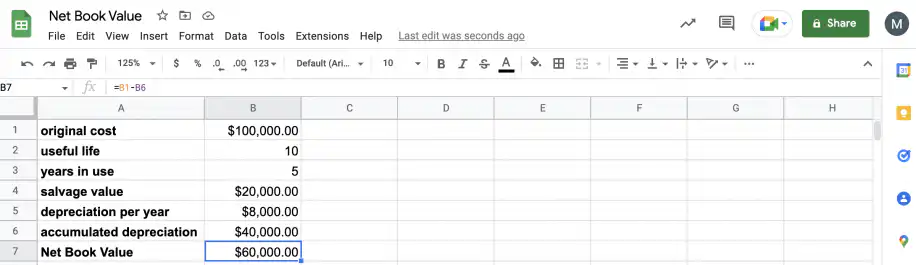
Imagine your company purchased a truck 5 years ago. The original cost was $100,000, the truck has a useful life of 10 years, and its salvage value is $20,000. Follow the steps below to calculate the current Net Book Value for the truck.
1. In Sheets, input the relevant values into separate cells.
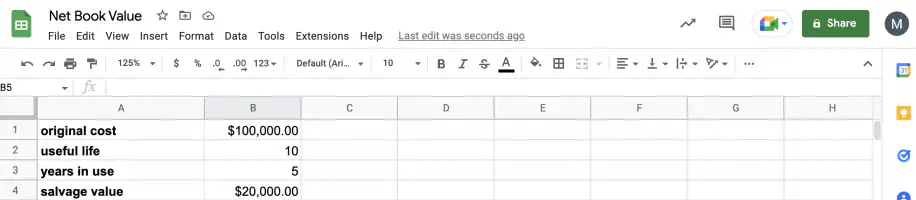
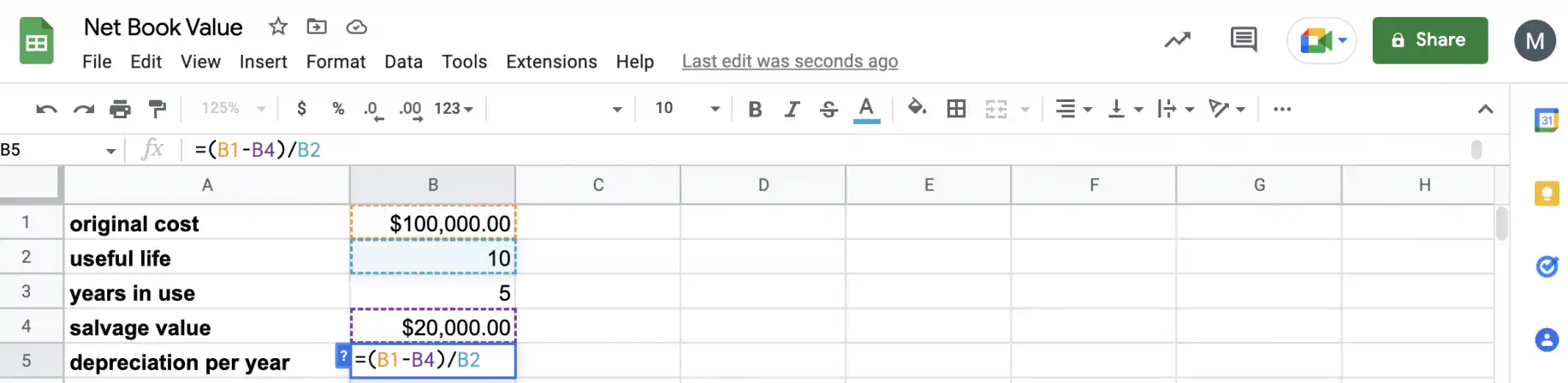
2. Type in the formula using the cell references from the previous step. You can calculate cumulative depreciation directly or first calculate yearly depreciation like below.
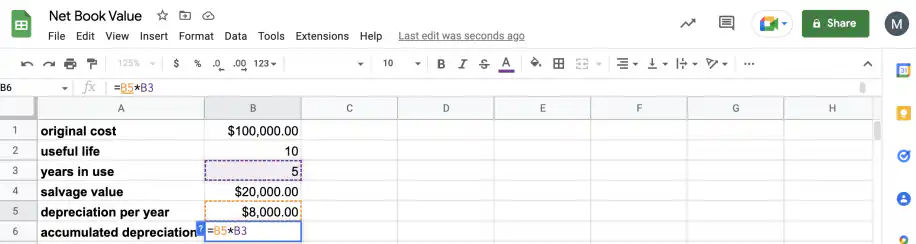
3. Multiply the yearly depreciation by the number of years that the asset has been in use to get the accumulated depreciation.
4. In a separate cell, type in the formula for the Net Book Value.
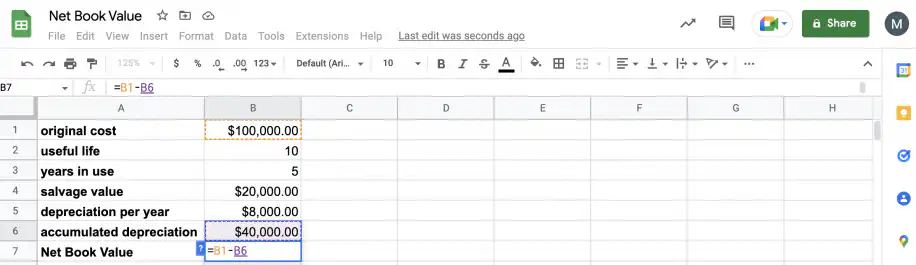
5. That’s it. The Net Book Value of the truck after 5 years is $60,000.
Calculate net book value using accumulated amortization
Imagine your company purchased scheduling software for $10,000 2 years ago. The software has a useful life of 5 years but no residual value at the end of its life.
1. In Sheets, input the relevant values into separate cells.
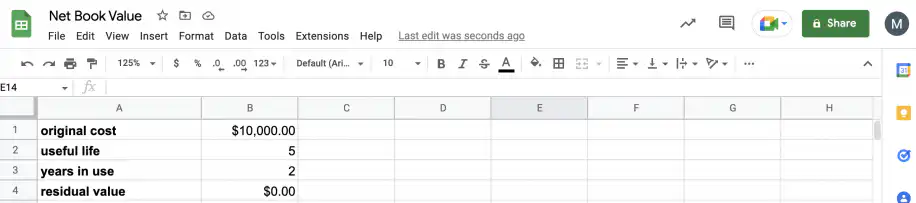
2. Type in the formula using the cell references from the previous step. You can calculate accumulated amortization directly or first calculate yearly amortization like below.
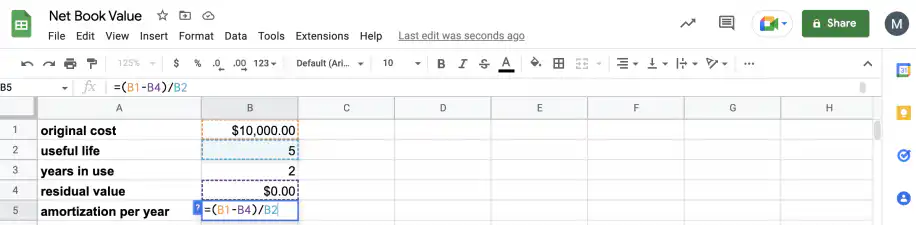
3. Multiply the yearly amortization by the number of years that the asset has been in use to get the accumulated amortization.
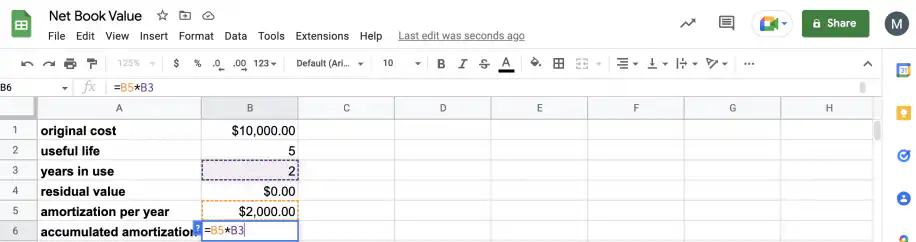
4. In a separate cell, type in the formula for the Net Book Value.
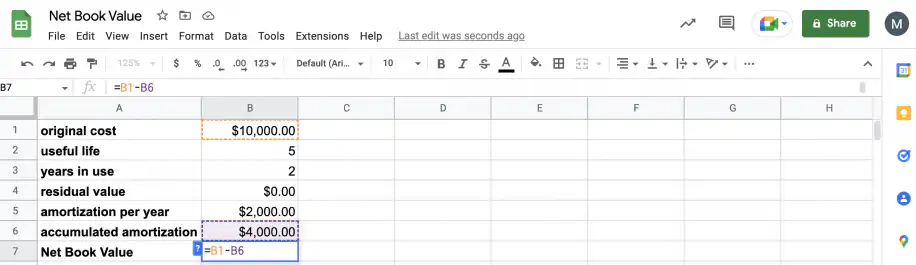
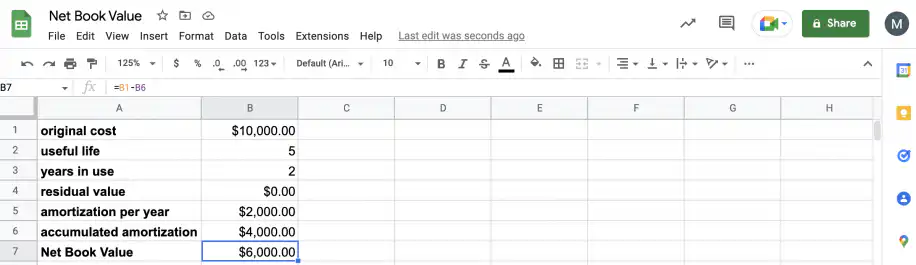
5. That’s it! You have the Net Book Value for the software after two years: $6,000.
Conclusion
As you have seen, Net Book Value is an important concept in financial reporting. Assets lose most or all of their value with the passage of time, so it’s important that this be accurately reflected in the books to provide an accurate picture of what the business is worth. However, just like with many aspects of financial reporting, it relies on estimates, such as an asset’s useful life and salvage value. In other words, the accuracy and usefulness of this measure will depend on the reliability of the information it’s based on.
You now know about Net Book Value and how it is calculated for different types of assets. You also know how to calculate Net Book Value in Google Sheets, so you can easily repeat your Net Book Value calculations using accumulated depreciation or accumulated amortization.
When your asset register is spread across several spreadsheets, Sheetgo’s AI finance virtual employee can collect the figures and keep your net book value calculations up to date.


 English
 Español
 Português do Brasil
 Français